


The Science of Wellness, Wellbeing, and Recovery
Hot, cold, and the case for both
Heat and cold do different things to your body, and a remarkable amount of what they do is the opposite of what your phone, your office chair and your sleep schedule are doing to you the rest of the week.
Two thousand years of bathing, thirty years of data.
Your nervous system was built for stress that arrives and ends
Comfort can drain your energy. Your body responds well to brief, intense bursts of thermal stress, like a sauna or an ice bath, which train your cardiovascular system and give you a reset from the daily routine.
The technical name is hormesis: a brief, controlled stress that triggers a recovery response much larger than the stress itself.1 Twenty minutes at 85°C, three minutes at 4°C, and your body answers each with cardiovascular conditioning and a hormonal response.
None of this is exotic. It is what humans did for two thousand years before central heating, and what a generation of researchers have been quietly measuring for the last thirty.

Four doors, one nervous system
Each works on its own. Together they cover the full thermal range, supporting recovery and long-term cardiovascular health.
| Way in | Temperature | Session | What it does |
|---|---|---|---|
| Hot tub | 37–40°C | 20–30 min | Buoyancy off-loads joint pressure and blood flow to the legs rises. |
| Sauna | 70–95°C | 15–20 min | A cardiovascular response from passive heat, with heat-shock proteins that help repair cells. |
| Ice bath | 2–5°C | 2–4 min | Noradrenaline and dopamine both rise sharply. |
| Swim spa | 26–32°C | 30–60 min | Full-body aquatic workouts, and swimming and relaxing all year round. |

Warm water is passive cardio for a stationary body
Hot tub · Hydrotherapy
Stiff joints and back pain? Warm water takes much of gravity's pressure off your spine, while the heat increases blood flow to help muscles recover and ease daily stress.
Hydrotherapy has measurable effects across the body's systems.2 In water up to the neck, buoyancy lifts about 90% of your body weight off your joints and spine,3 while heat raises your heart rate and increases blood flow to the legs.4 The result is a cardiovascular dose without the impact.
−5 mmHg
Drop in mean arterial blood pressure after 8 weeks of regular hot-water immersion, 4 to 5 sessions a week, in young sedentary adults.5
+95%
Improvement in flow-mediated dilatation, a measure of how well arteries widen, from 5.6% to 10.9% in the same 8-week study.5
Ready to bring hydrotherapy into your daily routine? Explore the hot tub collection.
The most-studied longevity habit nobody talks about
Sauna · Heat therapy
Feeling sluggish or struggling to switch off? Deep heat acts like a passive workout, relaxing tension and helping you wind down at the end of the day.
More than two thousand Finnish men were followed for over twenty years, and the pattern was clear: the more sauna sessions per week, the lower the risk of death from any cause.6 Researchers are still mapping the mechanisms behind it.1
-
−40%
Lower risk of death from any cause in men using a sauna 4–7 times a week, compared with once a week.6
-
−63%
Lower risk of sudden cardiac death in the same group of men.6
-
−66%
Lower risk of dementia in the same Finnish cohort, over about 20 years.7
Understand the mechanics? Choose your heat source from the sauna range.

Traditional · 80–95°C
Low humidity. Heats the air via a stove and stones. Suits social bathing and the deepest sweat.
Infrared · 45–60°C
Ambient humidity. Heats the body directly using far-infrared panels, at a lower air temperature.1
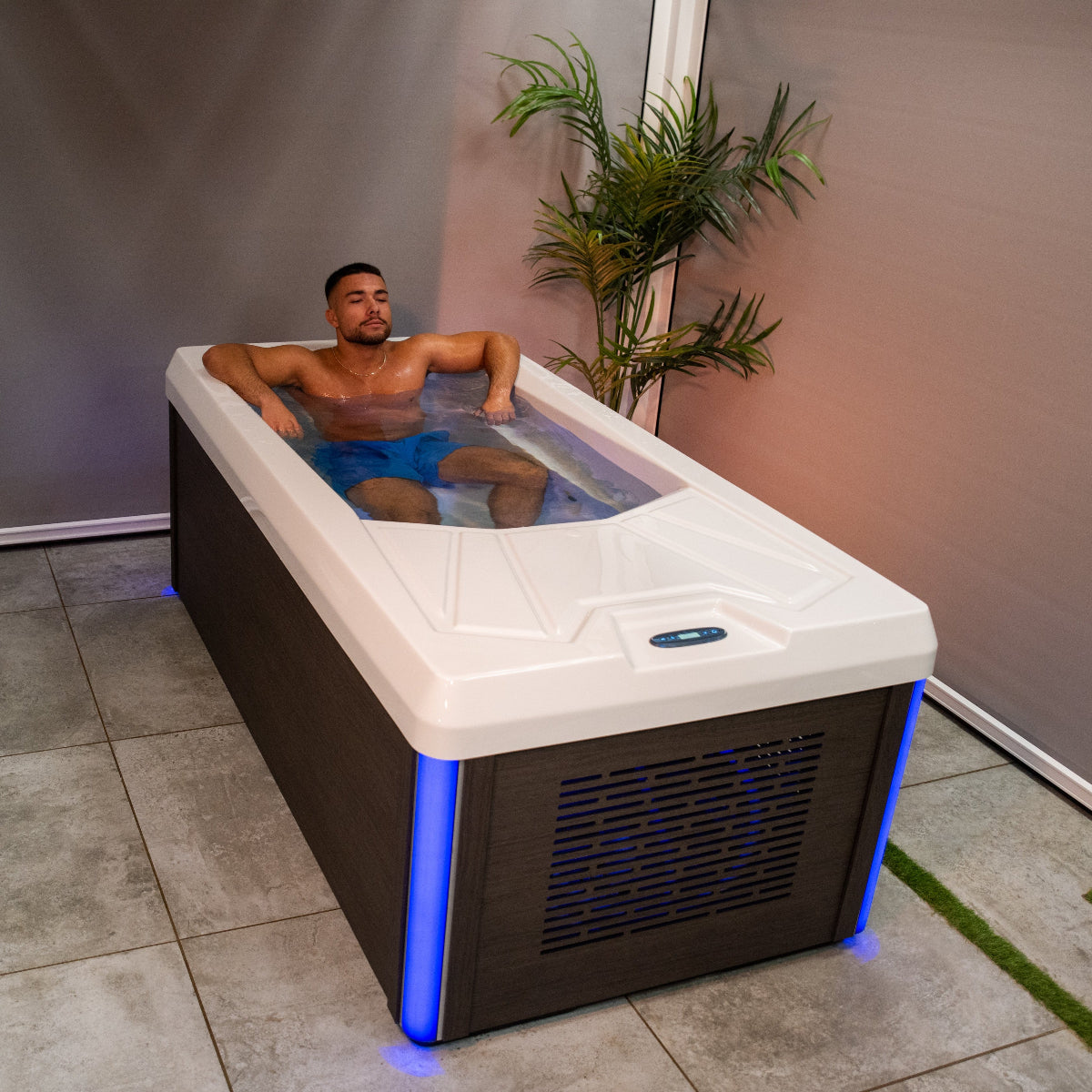
Three minutes of cold, a clearer head after
Ice bath · Cold therapy
Need a mental reset? A quick plunge sets off a surge of natural stress chemicals, leaving you alert and energised.
Cold immersion at 2–5°C is the shortest and most demanding of the four. In laboratory studies, cold-water immersion produces a large rise in noradrenaline and dopamine, two chemicals linked with focus and mood.8
A three-minute plunge, moment by moment
-
0:00
Skin contacts water. Blood vessels in the skin narrow and blood shifts towards the core.
-
0:30
Cold-shock response: a sharp inhale and a raised heart rate. Practice slows the gasp, and the response fades after about four immersions.9
-
1:30
Noradrenaline, linked with focus, mood and pain modulation, climbs. In a one-hour immersion at 14°C it rose by 530%.8
-
3:00
Exit. Re-warming begins. Dopamine also rises in cold-water immersion, by 250% in the same study.8
Prepared for the plunge? Discover the ice bath collection.
The ultimate environment for family fun, fitness and relaxation
Swim spa · Aquatic fitness
Want a pool without the massive footprint? Get a full-body aquatic workout against an adjustable current, then recover in the heated hydrotherapy seats. Year-round swimming, sorted.
Swim spas combine swimming with the hydrotherapy features of a luxury hot tub. Adjustable water currents let you swim in place for a full-body workout, while powerful jets provide hydrotherapy for muscle recovery.
365 days
Heated water for year-round aquatic fitness.
Low impact
Water carries most of your body weight while you swim against the current.3
Secure the best of both fitness and recovery in a single footprint with the swim spa range.

The case for contrast
Heat dilates. Cold constricts.
Cycling between the two, which Nordic bathers call contrast bathing, puts your blood vessels through the full widen-and-narrow cycle. It is a workout for the blood vessels themselves.
Heat or cold, alone
- Trains one half of the vascular response.
- Single-direction stress on the autonomic nervous system.
- Strong, well-documented cardiovascular benefits.
- Easier entry point: start with whichever fits the day.
Hot and cold, contrast
- Trains the full dilate-and-constrict response of your blood vessels.
- Strength and power return faster after hard exercise than with passive rest.11
- Heat and cold in one session: a few rounds of each.
One week, kept simple
In the research, the strongest sauna results come at four to seven sessions a week.6 Here is a balanced schedule designed for someone with full access.
Monday
Sauna2 × 15 min
Start the week with a solid cardiovascular load and build a steady routine.
Tuesday
Hot tub25 min
Passive recovery. Off-load the spine and let hydrotherapy soothe muscular tension.
Wednesday
RestFull day
Adaptation day. Allow your nervous system to absorb the thermal stress of the previous days.
Thursday
Contrast3 rounds
Sauna (12 min) to ice bath (2 min). Extreme vascular expansion followed by rapid constriction.
Friday
Sauna2 × 15 min
End the working week with a good sweat to release accumulated stress.
The weekend
Contrast and socialActive recovery, family time
Saturday contrast rounds, Sunday reserved for active aquatic recovery in the hot tub or swim spa.
Figures on this page are drawn from peer-reviewed research and represent average effects across study populations. Individual response varies. This page is general information, not medical advice. If you are managing a heart condition or pregnancy, speak to your GP before starting heat or cold therapy.12
Sources
- Patrick RP, Johnson TL. Sauna use as a lifestyle practice to extend healthspan. Experimental Gerontology, August 2021
- Mooventhan A, Nivethitha L. Scientific evidence-based effects of hydrotherapy on various systems of the body. North American Journal of Medical Sciences, May 2014
- Mayo Clinic News Network, Micah Dorfner. Aquatic exercise: Gentle on your bones, joints and muscles. 7 July 2015
- Thomas KN, van Rij AM, Lucas SJ, Cotter JD. Lower-limb hot-water immersion acutely induces beneficial hemodynamic and cardiovascular responses in peripheral arterial disease and healthy, elderly controls. American Journal of Physiology, Regulatory, Integrative and Comparative Physiology, 2017
- Brunt VE, Howard MJ, Francisco MA, Ely BR, Minson CT. Passive heat therapy improves endothelial function, arterial stiffness and blood pressure in sedentary humans. The Journal of Physiology, June 2016
- Laukkanen T, Khan H, Zaccardi F, Laukkanen JA. Association between sauna bathing and fatal cardiovascular and all-cause mortality events. JAMA Internal Medicine, April 2015
- Laukkanen T, Kunutsor S, Kauhanen J, Laukkanen JA. Sauna bathing is inversely associated with dementia and Alzheimer’s disease in middle-aged Finnish men. Age and Ageing, March 2017
- Šrámek P, Šimečková M, Janský L, Šavlíková J, Vybíral S. Human physiological responses to immersion into water of different temperatures. European Journal of Applied Physiology, March 2000
- Barwood MJ, Eglin C, Hills SP, Johnston N, Massey H, et al. Habituation of the cold shock response: a systematic review and meta-analysis. Journal of Thermal Biology, 2024
- Buijze GA, Sierevelt IN, van der Heijden BC, Dijkgraaf MG, Frings-Dresen MH. The effect of cold showering on health and work: a randomized controlled trial. PLOS ONE, September 2016
- Vaile J, Gill N, Blazevich AJ. The effect of contrast water therapy on symptoms of delayed onset muscle soreness. Journal of Strength and Conditioning Research, August 2007
- Hannuksela ML, Ellahham S. Benefits and risks of sauna bathing. The American Journal of Medicine, February 2001

Paul Margerison
Managing Director & Founder, Outdoor Living
Heat, cold and water are old habits with a growing body of research behind them. This guide sets out what the studies measured, so you can choose what suits your routine.